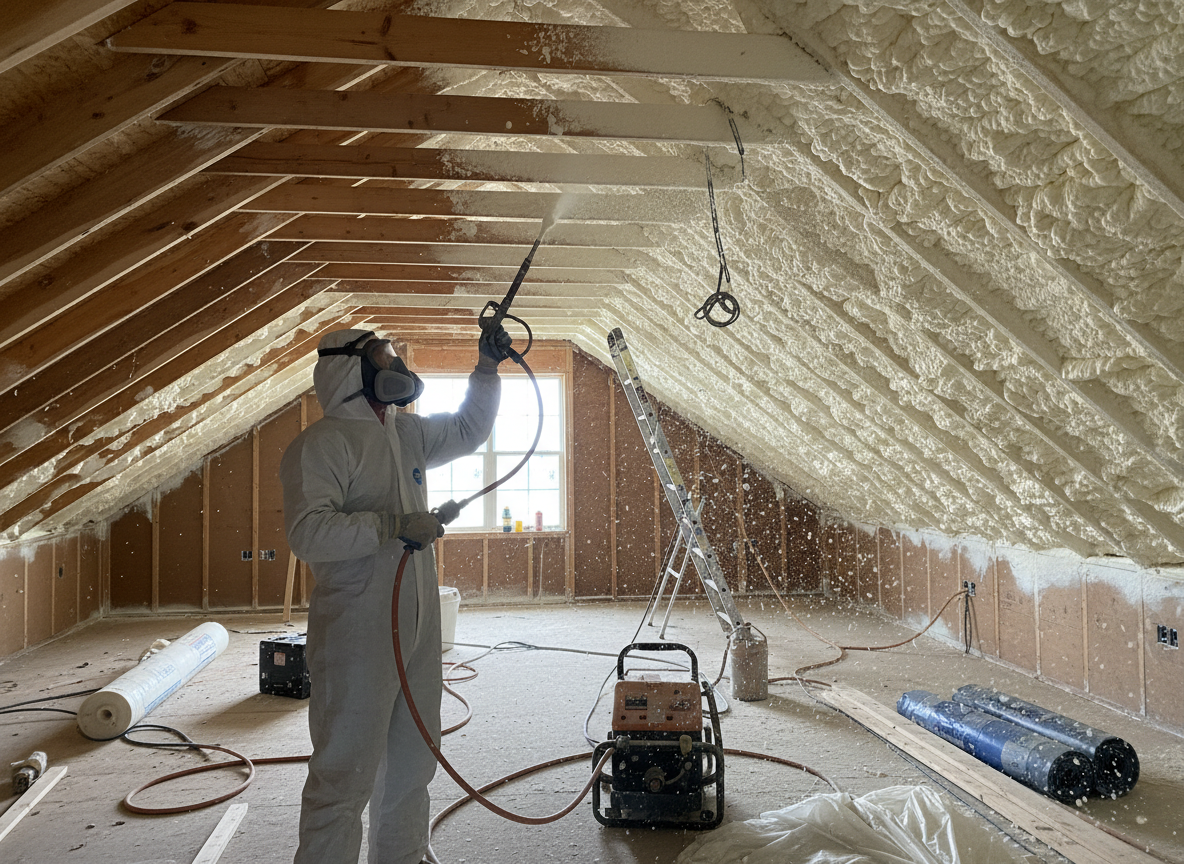
Spray foam creates an airtight seal in attics where older homes in Riverton Meadows often have gaps around recessed lights, plumbing stacks and ridge vents. In Salt Lake County’s semi-arid climate, hot summer days followed by cold winter nights cause rapid expansion and contraction that can pull conventional insulation away from framing; the foam stays bonded and limits heat transfer through the roof deck. Proper thickness also reduces the chance of ice dam formation along eaves during winter storms that move through from the west.
Application in Harvest Park and Western Springs requires checking existing ventilation paths first. Many 1970s–1990s homes here still rely on passive soffit-to-ridge airflow; blocking those paths with foam without adding baffles can trap moisture under the roof sheathing once spring runoff raises humidity. Technicians typically mask electrical boxes and use low-pressure formulations near knob-and-tube wiring still found in a few pre-1960 structures near Old Dome Meeting Hall.
Edge cases include cathedral ceilings common in custom homes near Riverton City Park and knee-wall cavities in split-levels. Closed-cell foam adds structural rigidity to rafters, which helps during high-wind events that occasionally funnel through the Jordan River corridor. Open-cell foam is sometimes chosen instead when homeowners want sound dampening between the attic and living space below without changing the roof’s load characteristics.
Technician insight
In Riverton the thing that catches most people out with spray foam insulation is older homes in Riverton Meadows that still have passive ridge vents but no baffles; if you spray right up to the sheathing without protecting those channels you trap moisture once the cold winter nights hit and the roof deck starts sweating.
Western Springs Attic Seal
Homeowner noticed uneven heating between upstairs bedrooms and the main floor during winter. Inspection found large gaps around plumbing vents and missing baffles in a 1980s split-level. Closed-cell foam was applied to the roof deck after baffles were added; the temperature difference dropped and no ice dams formed along the front eaves the following season.
How it works
- 1
Site Assessment
Inspect attic access, existing insulation, ventilation, and electrical or plumbing penetrations in Riverton homes.
- 2
Ventilation Protection
Install baffles or chutes to maintain airflow from soffits to ridge before any foam is applied.
- 3
Foam Application
Apply closed-cell spray foam to the underside of the roof deck and attic floor as specified for the climate zone.
- 4
Final Inspection
Check coverage depth, seal around penetrations, and confirm no ventilation paths were blocked.
Pricing
Pricing varies with attic size, access difficulty, and whether ventilation upgrades are needed; quotes provided after on-site review.