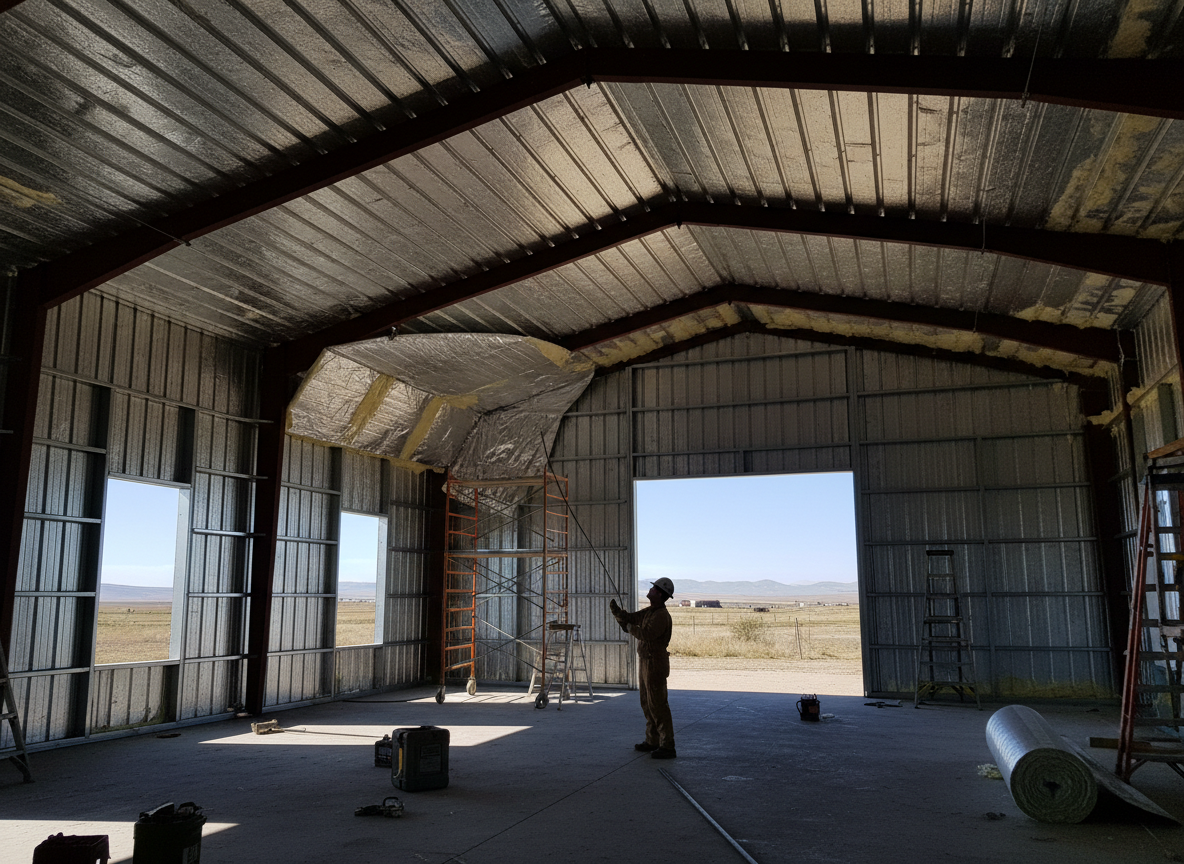
Metal buildings in Riverton Meadows and Western Springs often date back to the 1970s and 1980s ranch and light industrial stock common in Salt Lake County. These structures expand and contract sharply with the region's hot summers and cold winters, creating gaps at seams and fasteners that allow heat gain in summer and rapid heat loss in winter. Proper insulation requires closed-cell spray foam or rigid board systems with integrated vapor barriers to control condensation, which forms quickly when warm interior air meets cold metal during January lows.
Terrain around Harvest Park and near Riverton City Park includes wind corridors that drive dust and moisture under eaves. Installers must seal base plates and ridge vents thoroughly, as standard batts fail here due to sagging and air infiltration. In nearby Herriman and South Jordan, newer metal shops built on sloped lots need drainage considerations so insulation does not trap water from spring runoff or irrigation overspray common in the county.
Salt Lake County energy codes now emphasize continuous insulation layers on metal surfaces. Skipping thermal breaks at girts leads to visible interior sweating and corrosion within two seasons. Experienced crews use infrared scans before work to locate hidden voids, then install materials rated for the full temperature swing rather than generic R-values that ignore local diurnal changes.
Condensation Control in Local Metal Structures
In Riverton the biggest ongoing issue is interior moisture from temperature cycling. We always detail ridge and eave ventilation paths before insulation so trapped vapor can escape rather than degrade the metal over time.
Technician insight
In Riverton the thing that catches most people out with metal building insulation is skipping the thermal breaks at girts on older structures near Western Springs; the daily freeze-thaw cycle then pulls condensation straight through the metal and ruins the job inside two winters.
Metal Shop Insulation in Harvest Park
Owner called after noticing interior frost on the north wall during January cold snaps. We found missing insulation at the base plates and no vapor barrier on a 1980s metal building. Installed closed-cell foam with sealed seams and added ridge venting. Building now maintains stable interior temperatures without visible moisture.
How it works
- 1
Site Assessment
Inspect seams, fasteners, and existing ventilation on the metal building while noting exposure to Riverton wind patterns and nearby terrain.
- 2
Material Selection
Choose closed-cell foam or rigid boards with vapor barrier suited to Salt Lake County's hot-dry summers and freezing winters.
- 3
Preparation and Sealing
Clean surfaces, install thermal breaks at girts, and seal base plates against dust and moisture common in Western Springs.
- 4
Installation and Verification
Apply insulation in continuous layers, then scan for gaps before final trim and ventilation adjustments.
Pricing
Upfront quotes provided after on-site assessment; cost driven by building size, access, and whether existing metal requires corrosion treatment.